Caitlyn Jenner is here, and transgender issues are being brought to the forefront of the news. Therefore, there are a few things we need to be careful of as we discuss her and trans issues in general.
First, passing and transitioning aren’t necessary to be trans, be a certain gender, or be worthy. Transitioning is a choice that is that person’s business, and is often a privilege that many trans-identifying people can’t access. Passing is how someone is perceived and has nothing to do with someone’s identity–it has to do with societal expectations of gendered behavior and appearance (such as wearing “gendered” clothing, wearing makeup, having breasts). Not “passing” does not and should not invalidate someone’s identity or existence. Everyday Feminism’s Vivian Taylor provides some insightful words about the pressure put on trans people to be “passing.”
I personally identify as cisgender, and many cis people often (unfortunately) give attention or positive messaging toward trans people only when they are conventionally attractive (i.e., white, thin, etc.) and “pass” well. The term “passing” itself is controversial as it refers to being perceived by others as a particular gender/identity and can imply that the person isn’t genuinely what they are “passing” as.
In addition, media and news outlets rarely mention people who are nonbinary or people who don’t present their gender expression as the community at large wants them to – either incredibly masculine or incredibly feminine. Even when trans people are getting coverage, we are only covering the ones that fit into the gender binary of man/woman and the socially constructed appearances/behaviors for each, further denying the legitimacy of other genders and people who don’t present as extremely masculine or feminine.
This is a problem. Cis people should not define trans people by whatever makes cis people comfortable. Cis people don’t get to define trans people at all.
In the media, when we get trans coverage, the focus is usually on the individual. While it is important to tell individual stories to highlight a social issue, media must be careful not to forget the real issues the trans community faces and must not exploit the individual whose story they’re covering. Trans people often get asked inappropriate questions by interviewers about surgeries or their genitals, and often are asked what their “real name” is–both of these invalidate the trans person’s gender and identity. (GLAAD’s guideline for trans media coverage can be found here.)
However, we must also ask ourselves why these women are in the forefront of trans coverage. They both have had gender affirming surgery and look how society believes a woman should look. Would the coverage be different, or even exist at all, if it was about a trans person who didn’t fit into societal expectations of masculinity or femininity? If the person hadn’t transitioned? If the person was genderfluid?
The missing piece in media coverage is the community at large. At least 8 trans women have been murdered in 2015 so far, all but one of those being women of color. Out of 18 anti-LGBT homicides in 2014, 90 percent were people of color and more than two-thirds were transgender women.
The largest national survey on trans people found that they experience unemployment at twice the national rate of the general population, and that doubles to four times for trans people of color. 90% of trans people report being harassed or discriminated against on the job.
Trans people are 9 times more likely to attempt suicide, and 41% of trans or non-gender-conforming people attempt it at least once in their lives. Trans people are often misgendered, harassed, fetishized, and assaulted. These issues need to be at the forefront of the news, as well.
When we talk about Caitlyn Jenner…
- It’s okay to say she’s stunning! She is stunning!
- Don’t say things like, “She’s prettier than me!”
- This insinuates that being “pretty” is a criteria for being a woman.
- It implies societal definitions/standards for beauty, which focus on the white/cisgender/thin/etc.
- It implies that trans women aren’t expected to be beautiful or be “more beautiful” than cis people.
- It insinuates that only individuals assigned the female sex at birth are qualified to be pretty.
- Acknowledge that trans people don’t need to be “pretty” or “passing” to be worthy of praise.
- There are other amazing things that Caitlyn has done. She is brave, strong, self-accepting, and has acknowledged her (white/class) privilege in the past.
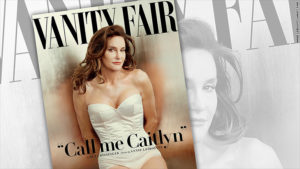
- Once Caitlyn’s Vanity Fair cover emerged, she was immediately sexualized by the media, and the only thing reported on was her appearance. Jon Stewart had a great segment on this on his show.
- Talk about larger trans issues. Violence, harassment, depression/suicide, triggering/offensive language, the privilege involved in being able to afford to transition if you so choose
- Realize and educate others that the only criteria for being a woman is identifying as one. That is it.
- If you’re wondering about what term to use, check out this list of useful terminology.
Image source: http://everydayfeminism.com/2015/06/trans-activists-need-to-remember-indp-of-jenner/